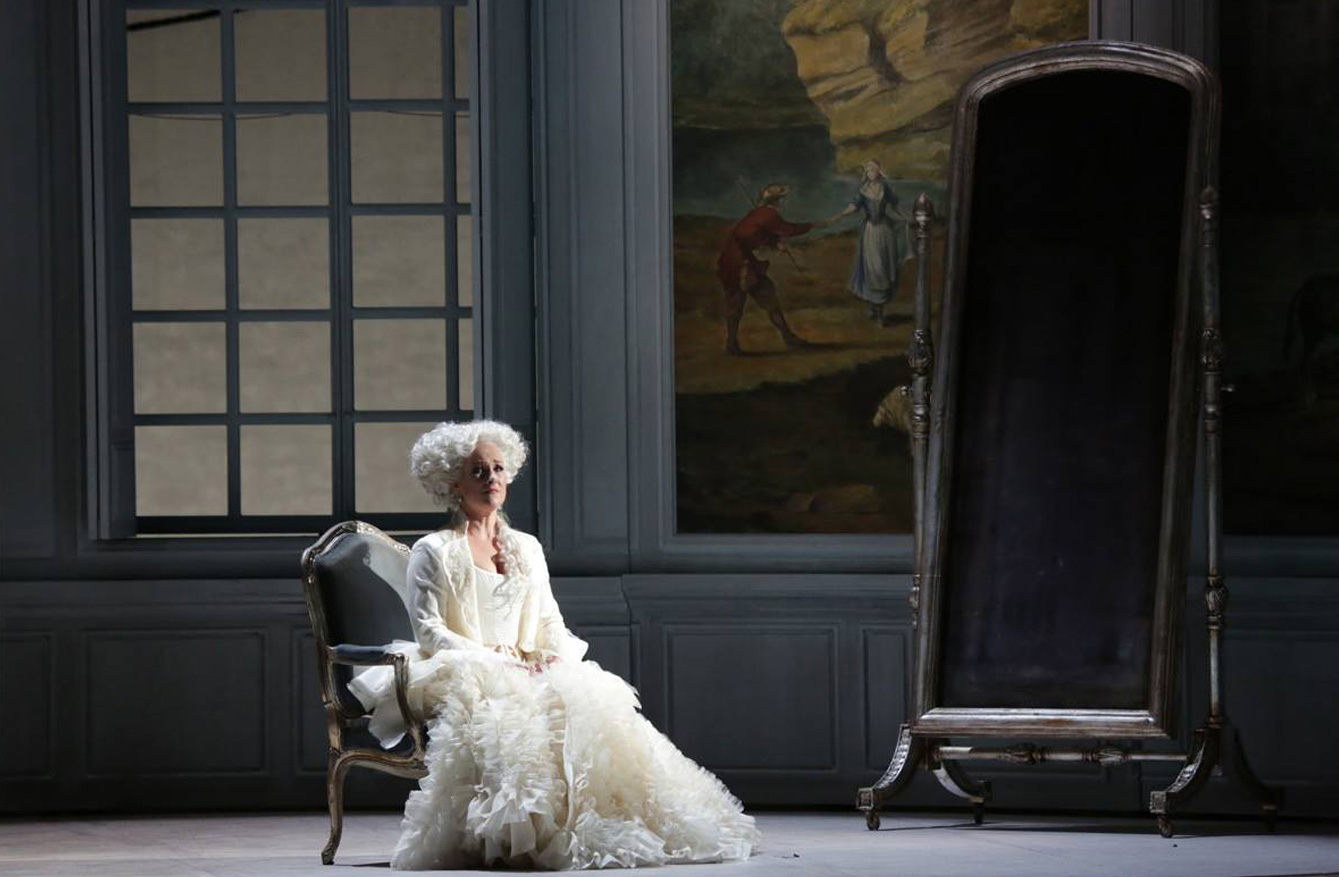

Les Pêcheurs de Perles, Metropolitan Opera
Jan. 1, 2016
„. . . a dream cast . . . delivers in this sensitive and insightful production . . . Ms. Damrau brings brilliant coloratura agility, radiant sound and charisma galore to the role of Leila. Her intensity comes with risks, since Leila is a virgin priestess who must keep her vows on pain of death, an edict enforced by the high priest Nourabad (Nicolas Testé, a fine bass-baritone), who accompanies her. In Act II, when Leila and Nadir, having reunited, sing an impassioned, fraught duet, Ms. Damrau’s body twitches with spasms as her character’s suppressed longings burst out . . . Ms. Damrau sang dazzlingly.“
Anthony Tommasini – The New York Times
„In Act II, Leila sings “Me voilà seule dans la nuit,” and behind her more divers appear, swimming through the air. It is spectacular, beautiful, and gives Leila an added dimension—she sings about the lurking presence of Nadir, but the production gives this the double purpose of a prayer that keeps the pearl fishers safe. Damrau’s sound was full of weight and emotion, making this one of the high points of the evening.
Both she and Polenzani sang with musicality and feeling. Their individual arias and the duet “Ton coeur” are some of the best parts of the score, and they clearly relished the chance to speak through the music.“
George Grella – New York Classical Review
„With Diana Damrau as Leila, the priestess who is the object of two friends‘ obsession; Matthew Polenzani as Nadir, the pearl diver who loves her; and Mariusz Kwiecien as Zurga, the village headman who is the third side of the love triangle, this Pearl Fishers is a real gem, as fiery and fervid as any of the more familiar tales of forbidden love, jealousy, and vengeance . . .
Damrau is in exquisite voice and whether singing from beneath a veil or flat on her back, she masters the delicate phrasing and vibrato of her thrilling second-act aria „Comme autrefois.“ And her love duets with Polenzani are full of ardent emotion, as is her third-act encounter with Kwiecien, pleading for her lover’s life.“
Wilborn Hampton – The Huffington Post
„. . . the Met has fielded a cast of superb vocalists who are also sensitive interpreters . . . The priestess Leïla conceals her face behind a veil much of the time, and soprano Diana Damrau accomplished a similarly elusive vocal effect with ravishing filigree high notes and soft fluttering trills. In the third act, when Leïla pleaded for her lover’s life, Ms. Damrau unleashed full, blazing tone including a ferocious chest voice . . .
Real-life pearl diving is apparently a million-to-one shot, but audiences for this Pêcheurs will enjoy much friendlier odds. Everything about it is a treasure.“
James Jorden – Observer.com
„Diana Damrau was an exciting, multifaceted Leïla. When she arrived, veiled in red and gold, the lightness and delicacy of her coloratura and the floating, spinning high notes as she prayed to Brahma and swore to fulfill her oath of purity and obedience were of a piece with the mystery and ritual of the role she is expected to play in the village. But her voice took on warmth for her forbidden love duet with Nadir, as he stripped away the gauzy layers of her sari to reveal the simple yellow dress beneath. And in Act III—her soprano bright and gleaming as she confronted the angry Zurga, begging him to spare Nadir’s life and cursing him when he refused—she emerged as a full-fledged woman, not a mere object of desire.“
Heidi Waleson – Wall Street Journal
„Diana Damrau’s Leila proved a rather passionate representation. Her early vocal displays were subdued and relaxed, emphasizing the virgin’s purity and submissiveness. Yet after seeing Nadir, her final oath was delivered with an emphatic declamation, expressing Leila’s newfound and conflicted emotions. Her first song at the end of the opening act was delicate in its delivery, the coloratura thrown off with relative ease. This was Leila again at her most pure and relaxed, though there was a frailty here, expressing Leila’s weak resolving regarding her oath. Moreover the final lines were delivered with far more weight, a sense of the erotic creeping into the legato.
The music of her aria at the start of her next act, also retains that reserve of the first song, but with a seeming desire for release. Damrau managed this delicate balance delivering her most remarkable singing on the evening. High notes seemed like they would blossom, yet the soprano managed to strike them ever so quietly and then let them grow in glorious crescendo. The ensuing duet is when the soprano let her voice finally hit its stride, the intensity of the passion between the two characters at its most vibrant. This was furthered in the final duet of the opera, Damrau and partner Matthew Polenzani blending their voices together beautifully; the colors, phrasing and dynamic shifts melding into one.“
David Salazar – Latin Post
„Damrau’s triumph in the role of Leïla. She was exotically beautiful in her orange-colored sari. Her disrobing by Nadir down to an equally lovely golden skirt, was demure, but tinged with eroticism. Vocally, Leïla provided Damrau with ample opportunity to display her lustrous tone, shimmering high notes and graceful coloratura. The icing on the cake, was her singing of the melody of the famous duet in the final act. One never really tires of hearing it, especially when sung by a voice such as hers.“
Rick Perdian – Seen and Heard International
„. . . the most important element was the singing, and the Met cast a winning team. Diana Damrau, for whom the production was mounted, has a shining lyric coloratura soprano that sounds more womanly than in the past, but she used the ornamentation in “O Dieu Brahma” to convey a fluttery girlishness. Her high diminuendos were breathtaking, yet she could also summon cutting power for her third act confrontation with Zurga.“
Susan Brodie – Classical Voice North America
„As Leïla, Diana Damrau sounded vocally restored –– her silvery, brilliant soprano precisely navigated the florid music but gained color and depth in the dramatic duets of the second and third acts. In fact, Leïla’s third act confrontation duet with Zurga, “Je frémis, je chancelle,” emerged as a vocal and dramatic highlight of the evening. Damrau’s sung French is excellent and she is a committed, positive performer.“
Eli Jacobson – Gay City News
„Damrau and Polenzani made it worth the wait, as the priestess Leila and the pearl fisher, Nadir, in a dynamic performance from the Met orchestra under Gianandrea Noseda. There was thrilling, ardent singing from the pair, in this updated staging from Penny Woolcock, originally heard at the English National Opera, which was slightly frantic but not enough to detract from these two able performers.“
Richard Sasanow – BroadwayWorld
The soprano’s glistening, agile soprano was a good fit for Bizet’s youthful score, written when CARMEN was not even a glimmer in his eye. It was a pleasure to hear her in „Comme autrefois“ and the gorgeous „O Dieu Brahma“–and she was equally matched by Polenzani’s beautiful singing in „Je crois entendre encore.“
„As Leila, Diana Damrau spends a good deal of time behind a veil, but there’s nothing retiring about the way she unleashes her voice, which gyres about the stage in a swirl of golden notes.“
Justin Davidson – Vulture
„With a score whose arias often end quietly, casting is unusually crucial, and the Met’s was thoughtfully chosen with Diana Damrau . . . The distinctive elements of Damrau’s role lie in the exotically ornamented, drawn-out cadences in her arias, to which she lent solid expressive purpose.“
David Patrick Stearns – WQXR
„Damrau improbably made Leïla’s capriciousness believable, even charming while singing with a lively approximation of French style and ravishing moonlit high notes. Her finely wrought trills were on display both in the swooning “Comme autrefois” and especially in a bewitching “O Dieu Brahma.”
That Leïla was more than a love-struck girl surfaced in her third-act confrontation with Zurga where Damrau rose to greater heights as she offered to die in the place of her beloved Nadir.“
Christopher Corwin – Parterre
„Perhaps the most difficult role to bring off convincingly amidst the general nonsense is that of Leïla, the not-so-chaste Hindu priestess at the center of the love triangle . . . Diana Damrau . . . is at her best here, rounding out Leïla’s “far-eastern” embellishments with lovely tone, exquisite high notes and perfect trills at every dynamic range and textual expressivity that made one actually care about her.“
Robert Levine – Bachtrack.com